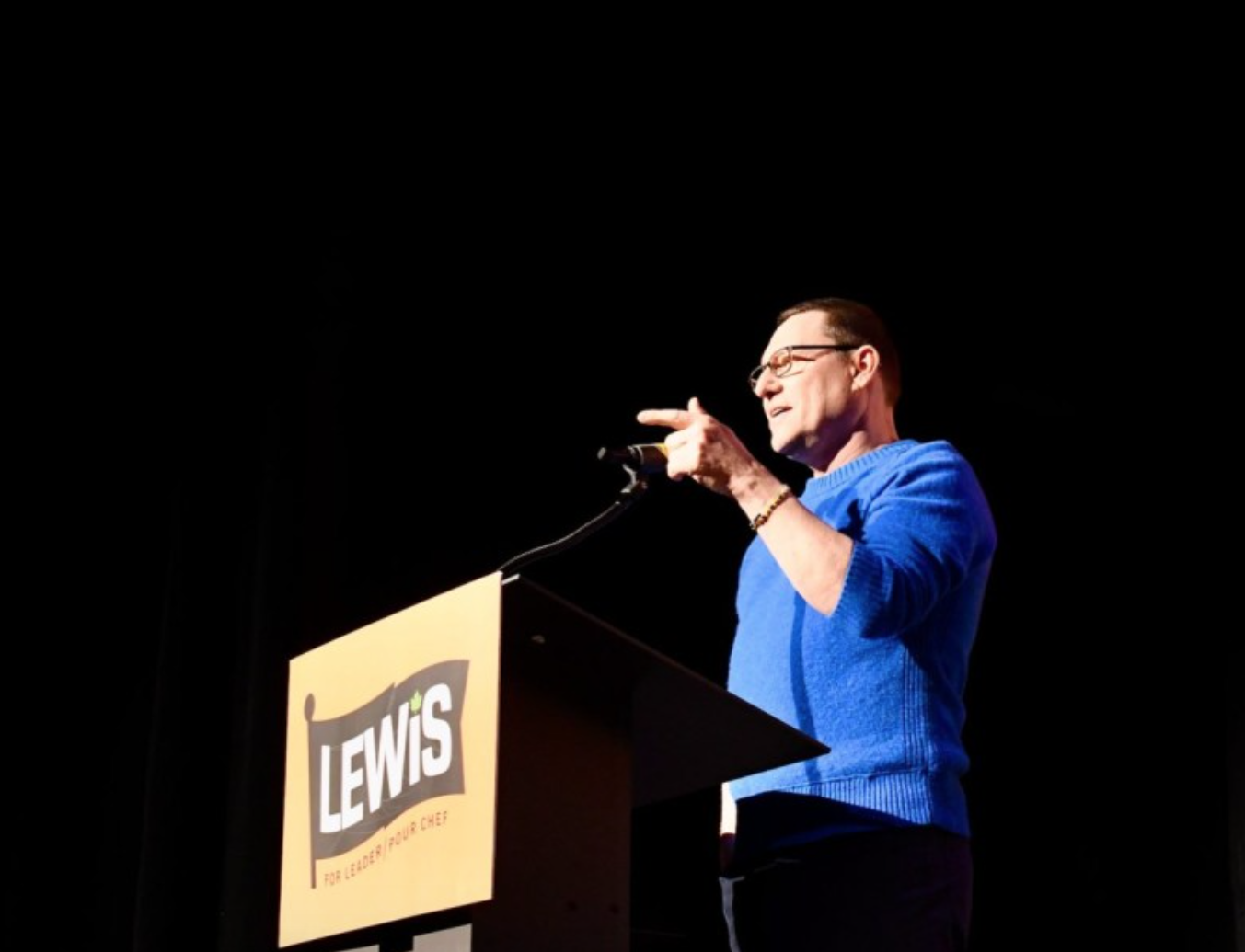
Avi Lewis must occupy the wide space on the centre-left that the Carney government has opened as it has shifted rightward in adopting key planks of the Conservative platform, writes Paul Moist.
“Avi Lewis is not afraid to ask and tackle the tough questions we face collectively. He has both the moral courage and the policy credentials that have the potential to add substance to the NDP. The party must embrace the opportunity that his candidacy represents.”
I wrote those words in these pages six years ago, as Lewis embarked upon the first of two unsuccessful bids for election to Parliament in both 2021 and last year.
He recently triumphed after a gruelling seven-month campaign, emerging as the first-ballot victor and the new leader of the federal NDP.
Full confession: I supported his bid for election in 2021 and marked my ballot in support of him as the new NDP leader. The stakes in 2026 are arguably much higher than they were five years ago, and the party starts from a diminished position, holding only six seats after suffering the worst electoral result in its 65-year history in the April 2025 general election.
The recent leadership campaign spoke volumes about the current state of the party. For the first time ever, the NDP was unable to attract experienced politicians. Only one candidate, Heather McPherson, was a sitting MP, and she has about six years’ experience. A poll on the eve of the convention revealed that almost half of over 1,000 respondents who had supported the NDP in recent elections did not recognize any of the candidates.
The leadership campaign did see membership almost double to about 100,000, but it did not garner much national attention in a political environment dominated by US tariffs and an uncertain economic future for our country.
As the campaign drew to a close, it was evident that Lewis had out-organized the rest. He raised $1.4 million—roughly equal to the combined total of all other candidates—and more than doubled his closest competitor, Heather McPherson, who raised $700,000.
It was also very clear in the final months of the campaign that this was, in fact, a two-person race. This was borne out in the voting results, with Lewis receiving 56 percent of the 71,000 total votes cast, compared to McPherson’s 29 percent. The other three candidates collectively received less than 15 percent of the vote.
Before turning to where Lewis might take the party forward, it is imperative to take a frank look at where the party stands today.
The 2025 election result cannot be ignored. The party is in a deep hole, including $13 million of debt, and the path back will be arduous.
Shortly after the 2025 campaign, the seven-person caucus showed the world how split they were when three members opted to publicly complain about not being consulted on the choice of Don Davies as interim leader. How on earth the party portrays itself as worthy of public support when a seven-person caucus cannot display unity is an unanswered question facing Lewis.
The decision by MP Lori Idlout to leave the NDP and join the Liberals further hurt the party, as does the likely departure of Montréal MP Alexandre Boulerice, who apparently plans to resign and run for Québec solidaire in the October 2026 Québec election. This will leave the NDP with five MPs and no seats east of the Manitoba–Ontario border.
Then there is the state of labour-NDP relations. The party was founded in 1961 after a four-year New Party initiative led by the Canadian Labour Congress and the remnants of the Co-operative Commonwealth Federation (CCF), which had been reduced to eight seats in the Diefenbaker sweep of 1958.
The formation of the NDP in 1961 saw substantial labour support. While it is true that unionized workers have never, en masse, supported the NDP, there was strong labour leadership support, and the social democratic project has enjoyed widespread support provincially and in terms of influencing federal decisions to expand the social safety net.
Contrast that with today, where the Canadian Union of Public Employees (CUPE) and the United Steelworkers are the only large unions openly in support of the party. Unifor, the largest private sector union in Canada, long ago abandoned support for the New Democrats, opting instead for strategic voting, not to mention the fact that it remains outside the CLC.
The sole labour candidate in the recent leadership race, Rob Ashton, won just six percent of the vote, despite the open support of the CLC president and the United Steelworkers—not exactly a high-water mark for labour as a force within the NDP.
One would hope that the upcoming CLC convention this May in Winnipeg presents an opportunity for labour as a whole to ask whether it wants a strengthened alliance with the NDP. I have always answered that question with an unequivocal “yes.” But I am not optimistic that this much-needed discussion is in any way imminent within the broader labour movement.
A formal labour alliance with a social democratic party is by no means a guarantee of success for workers. But non-alliance Gompersism is a prescription for labour isolation and decline.
Back to Lewis and his first days as leader. He has multiple issues before him, one being the tension with provincial NDP wings in Alberta and Saskatchewan. Tension between provincial wings and national parties is nothing new and is certainly not confined to the NDP.
In Newfoundland and Labrador, former Conservative Premier Danny Williams, in the early 2000s, ran a successful ABC (Anything But Conservative) campaign, which saw the Harper Tories shut out in the 2008 federal election.
In Saskatchewan, the provincial Conservatives changed their name to the Saskatchewan Party after a tense period with their federal party.
Manitoba Premier Wab Kinew, who spoke to the recent NDP convention, put it best in expressing his support for Avi Lewis, adopting a more constructive tone than the party leaders in Alberta and Saskatchewan, when he said: “When progressives have debates, have differences of opinion, we should view that as a sign of a healthy party and a healthy democracy… we don’t have to agree on everything in order to do big things together.
”Lewis is an astute man and wise enough not to succumb to media efforts to exploit divisions between the federal party and some of its provincial leadership. He showed wisdom in meeting Kinew in the Manitoba legislature within hours of his election.
Lewis would also be wise to accept the olive branch offered by former leader Tom Mulcair in a piece he wrote in the Montreal Gazette, saying: “Lewis ran an excellent campaign, he out-fundraised all of his opponents combined, and his vote total was of the same magnitude. He is clearly a force to be reckoned with.”
Notwithstanding past tensions between the two, Lewis should make time for Mulcair and deepen his support with all wings of the NDP.
Beyond consolidating support within the party itself, Lewis must occupy the wide space on the centre-left that the Carney government has opened as it has shifted rightward in adopting key planks of the Conservative platform.
Getting elected to Parliament is important, but it need not be priority one. Lewis cannot afford to lose a third straight election. As well, he has plenty of work to do in terms of connecting with Canadians. A seat in Parliament, while desirable and at some point necessary, does not mean as much when the party does not have official party status and the research funds, committee membership, and question period access that official status provides.
While Lewis’ left credentials are well established, he faces some key decisions in terms of what issues he will focus on. While there is no shortage of key challenges facing Canadians, it is critically important that his first months in leadership see him connect with citizens where they are, not where he may wish to take them.
Working families are suffering with rising cost-of-living realities, out-of-reach housing costs, and income insecurity. These are top-of-mind issues that Canadians will carry into the voting booth in elections at all levels.
Defence of workers and their legitimate demands has to be a top priority. Artificial intelligence remains unregulated and is the single greatest threat to the job security of all workers. Liberals and Conservatives seem content to leave things as they are—unregulated and unchallenged when it comes to AI. There is wide space here for a strong defence of worker interests, and Lewis ought to occupy it.
In 2019, in Winnipeg, I had the pleasure of attending the 50th anniversary convention of the National Farmers Union. Avi Lewis was the keynote speaker.
He quoted from a 1943 book written by his grandfather, David Lewis, co-authored with Frank Scott, Make This Your Canada: A Review of CCF History and Policy, saying:
[W]e may ask about our national unity, our sense of purpose. These should be a mark of a democratic society. Have we attained them? And finally, what progress have we made in securing and expanding our political and economic democracy? How far have we developed the various people’s movements such as trade unions, cooperative societies and political parties needed to promote and safeguard the rights of common people? These are the sorts of questions which anyone concerned about democracy will ask.
Canada writ large has benefitted greatly from its social democratic option as represented by the CCF-NDP. At the national level, the party is down, but it is not out. And Avi Lewis represents its best chance for renewal and success. I wish him well.
Paul Moist served as president of CUPE, Canada’s largest union, from 2003–2015. He currently serves as president of the Manitoba Federation of Union Retirees. He is a long-time NDP member.
Source: https://canadiandimension.com/articles/view/avi-lewis-labour-and-the-ndps-path-back-from-the-abyss