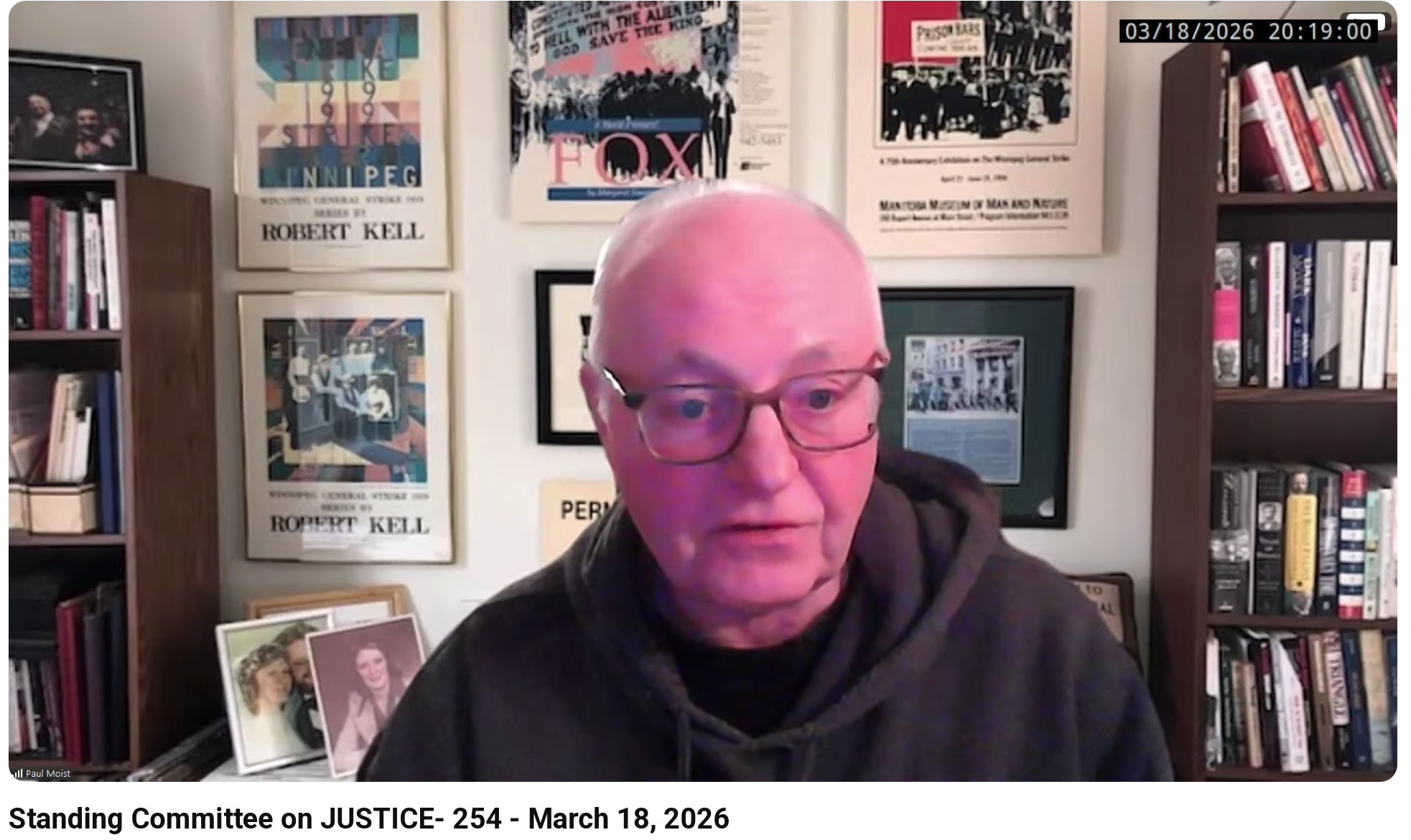
MFUR President Paul Moist made a presentation on March 18 to the Manitoba Standing Committee on Justice in support of Bill 4, The Constitutional Questions Amendment Act.
Bill 4 seeks to preserve fundamental human rights, including labour rights from the tyranny of the use of the notwithstanding clause to set aside such fundamental rights.
Read MFUR's presentation below:
The Manitoba Federation of Union Retirees (MFUR) is the Manitoba
affiliate of the 500,000 member Congress of Union Retirees of Canada
(CURC), chartered by the Canadian Labour Congress (CLC). We are
retired union activists and proud members of the Manitoba Federation of
Labour (MFL).
We appear this evening to support Bill 4. The use of section 33 of the
Charter, the notwithstanding clause, to set aside fundamental human rights,
is a worrisome trend.
Bill 4 will ensure that all such legislation, should it be introduced in
Manitoba, must first seek the Court of Appeals’ view on whether the
legislation violates section 2 or sections 7 to 15 of the Charter, and whether
the legislation is reasonable and demonstrably justified pursuant to section
1 of the Charter.
Our focus will be on labour rights, which we argue are Charter protected
and of fundamental importance in any democracy. Labour rights are, after
all, human rights.
The use of the notwithstanding clause to end legal labour strikes was first
used in Saskatchewan in 1986. The legislation was ultimately withdrawn
when the Supreme Court found that the legislation did not violate the
Charters freedom of association clause.
Charter interpretation has evolved since 1986, with the seminal SFL case in
2015 affirming that the right to strike was a fundamental feature of free
collective bargaining rights and was therefore, Charter protected
The next example of the use of Section 33 in a labour matter was the 2022
decision by the Ontario government to strip 55,000 education support
workers of their legal right to strike. The workers, with massive public
support, vowed to strike notwithstanding the introduction of Bill 28, the
Keeping Students in Class Act, which provided for massive fines for
individuals and unions should they strike.
Bill 28 was introduced on October 31, 2022, and received Royal Assent on
Nov 3rd, 2022. On November 8th, 2022, the government announced it
would not act on the legislation, and the union announced it would return to
the bargaining table. The legislation was repealed on November 14th, 2022,
and a negotiated deal was achieved on November 20th, 2022, and
subsequently ratified by both parties.
The latest example of the use of Section 33 involves the Alberta
government and their public-school teacher’s last fall. After legal strike
action of 23 days duration, the government introduced Bill 2, The Back to
School Act. The Canadian Civil Liberties Association called the
legislation, “unhealthy for Canadian democracy.”
The bargaining remains unresolved and the legislation is being challenged
in the courts. Professor Jason Foster of Athabasca University stated,
“Alberta’s move is unprecedented in provincial labour history and only the
third such use in Canada….It kind of makes a mockery of collective
bargaining.”
Canada’s federation of labour leadership, representing over 3 million
unionized workers, called Bill 28, “profoundly dangerous” saying, “when
rights become optional, they cease to be rights.”
Bill 4 seeks to preserve fundamental human rights, including labour rights
from the tyranny of the use of the notwithstanding clause to set aside such
fundamental rights. It is good legislation and we hope it receives the
unanimous support of legislature.
Thank you, I am happy to answer any questions you may have.
Paul Moist, President
Manitoba Federation of Union Retirees